Plastic Injection Molding at Production Scale
Plastic injection molding is the workhorse of modern manufacturing because it is the only process that economically combines tight tolerances, complex geometry, and unit costs that fall with volume. For procurement and engineering teams sourcing molded parts, the question is rarely whether injection molding is the right process — it is whether a given supplier can hold the part stable from the first article to the millionth shot. That stability is what separates a job shop from a manufacturing partner.
A molding program is a closed loop of tool design, resin behavior, press control, and verification. When those elements are managed together, the result is a part that looks identical to the drawing on every shipment. When they are managed separately — tool made in one country, molding in another, inspection somewhere else — variation creeps in and shows up as scrap, line-down events, and field returns. The value of consolidating the loop under one roof is the single most important thing to verify when you evaluate a molder.
What the Capability Numbers Mean for Your Program
Specifications look impressive on a brochure, but buyers should read them as commitments about what a supplier can actually deliver. A 50-ton to 800-ton press range means a single facility can run everything from small precision inserts to large automotive and appliance housings without splitting your program across vendors. Shot weights up to 2,000 grams and tolerances of ±0.02 mm on critical features describe the envelope in which the process is predictable rather than heroic.
Mold life rated at 300,000 to 1,000,000 shots is not a sales figure — it is a maintenance plan. Tools are serviced by shot count, not by failure, so wear is scheduled and never surprises a shipment. Tooling lead time of 15 to 35 days reflects how quickly steel can be cut and validated when engineering and molding share a building. And an annual capacity above 50,000,000 parts signals that the floor is built for sustained volume, with automation and material handling designed for consistency, not just peak throughput.
How a Production Program Runs
Every program at the Dongguan facility follows the same disciplined path, and each step has an owner and a record:
- Design for manufacturability (DFM). Wall thickness, draft, gating, ejection, and tolerance stack-up are reviewed before steel is cut. Most quality problems are designed out here, where changes are cheap.
- Tool fabrication. The mold is machined from the selected steel, fitted with the chosen runner system, and validated on a tryout press.
- Material preparation. Resin is dried to specification and color-matched, then fed through a controlled system so the process starts from a known-good baseline.
- Molding. Molten thermoplastic is injected into the closed mold, packed under controlled pressure, and cooled to a stable shape.
- Ejection and handling. The solidified part is removed by robot and routed to inspection or downstream operations, minimizing manual variation.
- Verification. Critical dimensions are checked with CMM and in-process gauges; results are recorded for traceability.
The point of this structure is not ceremony. It is what turns a one-off good part into a million identical good parts, and it is what lets your incoming inspection confirm rather than discover.
Choosing the Right Resin
Material choice drives cost, performance, and regulatory exposure more than any other decision. The table below maps common engineering thermoplastics to the properties that matter in a sourcing decision.
| Resin | Key properties | Typical applications |
|---|---|---|
| ABS | Impact resistance, easy to finish | Enclosures, housings |
| PC | Optical clarity, heat resistance | Lenses, transparent covers |
| PP | Chemical resistance, fatigue life | Fluid parts, living hinges |
| PA6 / PA66 (Nylon) | Strength, wear resistance | Gears, structural components |
| POM (Acetal) | Low friction, dimensional stability | Precision mechanical parts |
| TPU | Soft-touch, sealing | Grips, gaskets |
| PBT | Electrical insulation | Connectors, terminals |
Selection is matched to function, environment, and regulatory requirements. For flame-retardant, glass-filled, or food-contact applications, the specific grade is qualified and the documentation your compliance team needs is maintained from the first lot.
Equipment and Plant Capacity
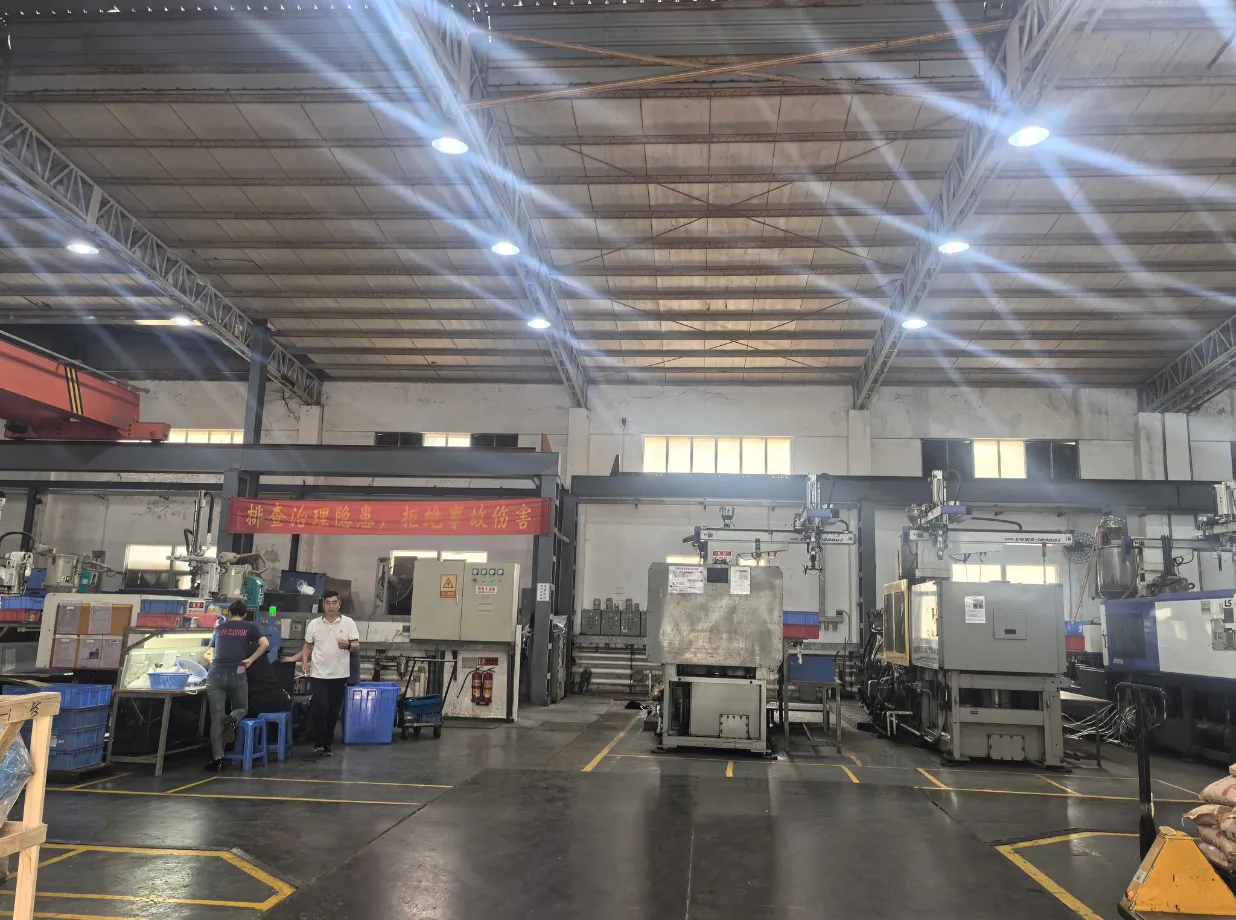
The Dongguan molding floor runs computerized 50T–800T presses with closed-loop process control and cavity-pressure monitoring.
The plant runs a fleet of computerized machines from 50T to 800T, all with closed-loop control and cavity-pressure monitoring. Hot-runner controllers, dehumidifying dryers, and central material handling keep resin conditions stable across long runs. Clamp force, shot size, and tie-bar spacing are matched to each tool so the press operates in its optimal window rather than at its limit. Robotic part removal, integrated insert loading, and automated packaging reduce human variation, and in-mold sensing with SPC charting catches drift before it becomes scrap.
Applications and Where They Fail

Industrial and electronic plastic components where dimensional precision and insulation determine field reliability.
Precision molding appears wherever a part must be light, consistent, and produced in volume. Each application carries its own failure mode, and process controls are tuned to the requirement rather than applied generically:
- Housings and enclosures for electronics, sensors, and control units — flatness and fit dominate.
- Connectors and terminals — dimensional precision and insulation are non-negotiable.
- Gears and bushings — concentricity and surface finish drive wear life.
- Fluid system components — sealing and chemical resistance prevent leaks.
- Consumer product shells — appearance, feel, and cost must balance.
For EV and energy storage programs, battery module and charging hardware components are produced using flame-retardant engineering resins under controlled process discipline, where a single non-conforming part can affect an entire pack.

Plastic components for EV charging piles and battery modules, molded from flame-retardant engineering resins.
Industry Nuances Worth Asking About
The capability cards above summarize the sectors served. The detail that affects your program is how requirements differ by sector: automotive demands PPAP documentation and traceability; medical demands cleanliness and lot records; electronics demands fine features and flatness; EV energy demands flame-retardance and consistency; industrial demands durability. A supplier who has shipped to all five brings pattern knowledge from one sector into another — the kind of cross-pollination that surfaces during a DFM review.
Quality and Compliance Expectations
Quality is engineered, not inspected in at the end. The facility operates under an ISO 9001 quality management system with documented controls at every step: incoming material verification, first-article inspection, in-process SPC, and final audit against the approved drawing. Dimensional verification uses CMM and calibrated gauges, with critical characteristics tracked lot by lot. For regulated industries, the records and traceability needed for audits and field recalls are retained, and customer-specific protocols including PPAP documentation packages are supported where required.
Cost and Lead-Time Drivers
Buyers often fixate on piece price, but the total cost of a molding program is set earlier and elsewhere:
- Tool steel and cavitation — more cavities lower piece price but raise tool cost; the right balance depends on volume.
- Resin grade — glass-filled and flame-retardant grades cost more and mold differently.
- Tolerance and finish — tighter specs and high-gloss finishes add process and polishing cost.
- Secondary operations — printing, welding, and assembly add handling but can lower your landed cost versus multiple suppliers.
- Volume and cadence — steady runs amortize setup and stabilize pricing.
Lead time is dominated by tooling, not molding. A well-run DFM and a tool shop in the same building compress the critical path from design release to first article.
Low-Volume vs. Production Molding
Not every program needs a hardened million-shot tool. The table below helps frame the choice between short-run and full production molding — both are offered, and the right one depends on your forecast.
| Factor | Low-volume molding | Production molding |
|---|---|---|
| Typical quantity | 100 – 100,000 parts | 100,000+ parts |
| Tooling | Soft or pre-hardened steel | Hardened steel, multi-cavity |
| Unit cost | Higher | Lower at volume |
| Best for | Spares, niche, pre-launch | Stable, high-demand products |
Common Defects and How They Are Prevented
Warpage, sink marks, short shots, and flash are symptoms of process ignorance, not bad luck. They are prevented by understanding how melt temperature, injection speed, packing pressure, and cooling time interact for each resin family — and by validating those settings on a tryout press before a production commit. Cavity-pressure monitoring confirms every shot fills completely, and SPC charts flag drift before it becomes scrap.
What to Include in Your RFQ
A precise quote depends on a precise request. Send your 3D model and 2D drawing, the target resin (or the performance requirement if resin is open), annual volume and lot sizes, critical dimensions with tolerances, surface finish and any color, and any regulatory or documentation needs. The more defined the package, the more accurate the tooling and piece-price estimate — and the fewer the surprises after award.
Design Guidelines That Protect Your Program
Good molded parts are designed before they are tooled. Wall thickness should be as uniform as the geometry allows, because thick sections cool slowly and sink while thin sections fill reluctantly and short. Draft angles let parts eject cleanly without drag marks, and generous radii reduce stress concentrations that cause cracking in service. Gate location belongs where it will not scar a visible face or starve a long flow path, and tolerance callouts should follow function — tight only where fit, sealing, or assembly demand it. These are the details a DFM review resolves, and resolving them early is cheaper than correcting steel later.
Tolerances, Inspection, and Documentation
Drawing tolerances should be assigned by function, not applied uniformly. Critical dimensions get the standard ±0.02 mm; non-critical features can carry commercial tolerances, which lowers cost and scrap. Inspection is confirmed by CMM and calibrated gauges, with critical characteristics tracked lot by lot and first-article reports supplied on request. For regulated programs, lot traceability and PPAP documentation packages are supported so your quality team can release incoming material without re-deriving evidence.
Secondary Operations Under One Roof
Molded parts often need more than the shot itself. In-house polishing to SPI A/B/C/D, VDI and Mold-Tech texturing, painting and coating, pad printing, laser engraving, and ultrasonic welding mean a finished, ready-to-assemble component can ship from one supplier. Consolidating secondary work removes interface risk between vendors and usually lowers your landed cost compared with coordinating several specialists.
Cost Structure and How to Control It
The piece price is the visible part of cost; the tool, resin grade, cavitation, tolerance, and secondary operations set the total. More cavities lower piece price but raise tool cost, so the right balance follows your volume. Glass-filled and flame-retardant grades cost more and mold differently. The most reliable way to control cost is a disciplined DFM that prevents iterations — every rework loop after steel is cut is more expensive than the same change made on the drawing.
Lead Times, Logistics, and Confidentiality
Tooling dominates lead time, and a clean DFM with in-house fabrication compresses the path from design release to first article. Parts are packaged to survive transit and labeled to your specification, with barcode and lot traceability available, and the plant ships to North America, Europe, and Asia with the documentation international logistics requires. Drawings and models are handled under standard confidentiality; proprietary geometry is protected as customer property, not reused.
Evaluating a Molding Partner
When you shortlist suppliers, the questions that separate a partner from a job shop are practical: is tooling built in-house or outsourced? Are process engineers available during DFM, or only at the press? What quality documentation ships with each lot? Can the plant show PPAP experience for your sector? The answers predict whether your program stays predictable at volume — which is the real measure of a supplier.
What a Typical Production Program Looks Like
A representative program for a high-volume enclosure runs roughly as follows. Week one to two: DFM review and quote, with design changes agreed on the drawing. Week three to six: tool fabrication and tryout, including CMM validation of the cavity. Week seven: first-article inspection and approval. Week eight onward: ramp to steady production with SPC on critical dimensions and monthly lot traceability. The same shape applies to connectors, gears, and fluid parts — only the resin, cavitation, and inspection depth change. Knowing this timeline helps you plan your own launch and spot a supplier whose schedule lacks defined gates.
Industry-Specific Considerations
Automotive programs expect PPAP documentation and traceability from the first lot. Medical programs add cleanliness controls and lot records that survive audits. Electronics programs push fine features and flatness, where a few microns decide fit. EV and energy storage programs specify flame-retardant resins and consistent behavior across a pack. Industrial programs prioritize durability under load. A supplier who has shipped to all five brings pattern knowledge from one sector into another during your DFM review.
Glossary of Key Terms
- Cavity pressure monitoring — sensors confirming every shot fills completely.
- DFM — design for manufacturability, the pre-tooling engineering review.
- Hot runner — a heated manifold that eliminates cold sprue waste.
- PPAP — production part approval process, the automotive quality standard.
- SPI finish — the U.S. mold surface finish classification from high-gloss A to textured D.
- Tolerance — the permissible deviation from a nominal dimension, assigned by function.
Decision Guide
When plastic injection molding is the right choice. This process pays off once your annual demand reaches the tens of thousands of identical parts and stays there. If you need the same component repeated with consistent wall thickness, dimensional stability, and surface finish across years of production, molding beats machining, printing, or assembly on both unit cost and uniformity.
Factors that shape the decision. Volume is first: below a few thousand parts, tooling amortization rarely works. Then part size and resin—larger shot weight and engineering grades raise machine and material cost. Tolerance bands, cosmetic class, regulatory exposure (medical, food, automotive), and required secondary operations all move the number. A realistic total-cost view weighs tool life against per-part price.
Mistakes buyers avoid. Under-specifying the resin and discovering creep or chemical failure in the field; ignoring mold shrinkage and gate location until parts don’t fit; skipping a DFM review and paying for it in revisions; and selecting a supplier on piece price alone while sacrificing traceability and delivery discipline.
Engineering Considerations
Design and DFM. Good parts are designed for the process: uniform wall sections (typically 1.5–3.0 mm), generous fillets, draft on every vertical face, and gating placed where it won’t mar a cosmetic surface. Ribs and bosses add stiffness without thickening walls. DFM feedback before tooling prevents the most expensive class of change—steel edits after first articles.
Tolerances. Standard molded tolerances run around ±0.05–0.10 mm per 25 mm, tightening with process control and loosening with large flat areas and glass-filled resins. Call out only the features that truly matter; over-tolerancing every dimension inflates cost and scrap.
Material selection. Match the resin to the failure mode: PEI or PEEK where heat and strength dominate, PP where chemical resistance and hinge life matter, PC/ABS where impact and cosmetics intersect. Moisture-sensitive grades (PA, PBT) need pre-drying and sealed handling.
Cost and Lead-Time Factors
Tooling cost drivers. Cavitation, steel grade, hot-runner complexity, side actions (slides, lifters), and textured or polished surfaces set the tool price. A single-cavity P20 tool and a 16-cavity hardened tool are different orders of magnitude.
Volume impact. Per-part cost drops steeply as the tool amortizes over higher runs; the breakeven against aluminum or machined alternatives usually lands in the low five figures of parts.
Material, finishing, and quality impact. Engineering resins and filled grades cost more and wear tools faster. Painting, plating, printing, and ultrasonic welding add steps and handling. Tightened inspection (SPC, FAI, lot traceability) adds a small but real overhead that most regulated programs require.
Production Scaling
From prototype to mass production. A qualified prototype tool validates design and material; the production tool then scales cavitation and hardens steel. Reusing DFM learnings keeps the transition short.
Repeatability and consistency. Documented process windows, qualified resins, and first-article baselines let the line hold the same result across shifts and years. Mold maintenance intervals protect that consistency.
Supply chain. Keeping tooling, molding, and finishing under one roof removes the hand-off risk between vendors and shortens the critical path when volume ramps.
Buyer Checklist
- Confirm annual volume justifies tooling amortization.
- Supply a 3D model, 2D drawing with critical tolerances, and resin spec.
- Note regulatory marks (UL, FDA, RoHS, REACH) and end-use environment.
- List required secondary operations and cosmetic class.
- Ask for a DFM review and a mold-flow summary before steel is cut.
- Agree on inspection level, packaging, and forecast-based delivery.
Related Capabilities
Explore the surrounding services that feed into a complete program: Custom Plastic Injection Molding for bespoke geometry, Injection Mold Manufacturing for the tooling that defines part quality, Prototype Injection Molding for pre-production validation, and Low Volume Injection Molding for short runs. The full capability overview is on the homepage.
For commercial terms, drawings, and contract manufacturing, visit plasticmolder.com, the contact page, or the dedicated plastic injection molding and custom plastic injection molding pages.